Showing posts with label temple art. Show all posts

18 January 2016

Aa udayaar


Thiruperundhurai is an ancient shetram in Pudukkottai region.


This town is also called as Aa udayaar koil after the temple constructed by Sri Manivaasagar, one of the four prime gurus of Tamil Saivism. He constructed this temple while he was the Chief Minister of Pandyaa Kingdom.

Soul is referred as ‘Aa’ or ‘pasu’ in Tamil Saivism.  ‘Udayar’ is a term to refer the king or owner or head of a kshetram i.e. place – indicating God Shiva – and Pandya Kings used to assume this title name.  So Aaudayaar is the King of all the souls. Adma Naathar is the Sanskrit version of Aa udayaar.


Manivaasagar constructed a temple to Aaudayaar while he was at the service of Paandyaa king probably during the 8th century. At that time he was on an important royal mission. He was under the orders of the Paandyaa King at Madurai to urgently procure imported horses from the sea shore ports for the Paandyaa cavalry. The King wanted to strengthen his dwindling cavalry units.

The rest of the story is a Shiva Leelaa…..the popular Thiruvilayaadal……..associated with Madurai.

A visit to Thiruperundhurai temple is an ethereal experience.

Extensive later works by several Kings and Chieftains expanded around the core of the temple over a period of 12 centuries. The temple has many unique features standing apart from other Saivite temples of Tamilnaadu…..

There are no forms ………no icons to indicate the God……..No Shiva vigrahaa or lingaa…..even no nandhi / Rishab to represent the soul….but is only a pedestal at the sanctum sanctorum…..

Other important iconic representations of Savite temples such as Dhwajasthamba and Chandikeswara are also absent in this temple. More curiously the temple is southward looking unlike other East/ west looking Shiva temples.

The temple indirectly represents the Saivite concept of seeing God in eight tangible forms - the five elements, the Sun, the Moon and the Self i.e. Atman or soul. Figurative representation of the above eight forms are carved in the ceiling slabs of Maha mandap i.e. the next mandap / hall to the sanctum sactorum.  

Since there is also no iconic representation for the soul, this temple is said to represent the ‘oneness’ or the Adhvaithik concept of unification of soul with the almighty. Perhaps the concept means merging of soul with Shiva? By the way,  ‘Merging with shiva’ is one of the triology of the American Saivite Guru, Sri Satguru Sivaya Subramanya Swamy of the Kauai Hindu Monastery in Hawai.

Shiva is worshipped in roopa, aroopa and roopaaroopam forms i.e. form, formless and partial forms in saivite tradition. The linga form is considered as roopaaroopam form. Guru Jaggi Vasudev considers linga as three dimensional form of an elliptical representation. He enunciates such elliptical form as a natural geometric form found in the universe….…. from galaxies and orbits of planets to electronic course in atomic structure.

I would like to moot the possibility of a closely similar notion that the linga icon might be the three dimensional form of the most profound symbol across the civilizations, across the time i.e the circumpunct….

By the way, ‘Stauros’ is the Greek word meant for cross but literally meaning only a stake or pole which is actually a three dimensional form of a circumpunct i.e. the elliptical icon used by the ancient civilizations across the World…..

However the indications and even symbols over the period might have undergone adoptions and mutations.  However, the circumpunct symbol is almost ubiquitous in the temples of Tamil Nadu – particularly in the segments where the Chettinaadu works were undertaken. Chettinaadu works are particularly abundant with the yin-yan and circumpunct motifs across Tamil Saivite temples.


this circumpt motif I found in Thiruvaanaikka Temple, Trichy
Another notion is that the similarity of nuclear reactors' design /shape to the lingam form may be due to similar reasons.....


All Shiva temples deify God in 'roopa-aroopa' form. There are only very few ancient Shiva temples with 'roopa' form such as Piraan Malai and Thiru Malai – two ancient rock cut temples near Madurai.

Aa udayaar temple is the only revolutionary temple in the Tamil lands and perhaps in the entire World so beautifully depicting God in a formless form.

Sri Manivasagar’s Thiruvaasagam, one of the six celebrated works of the classical Tamil says in a mirthful way,

       'ஒரு நாமம் ஓருருவம் ஒன்றுமில்லாற்கு ஆயிரம் 
        திருநாமம் பாடிநாம்  தெள்ளேணம் கொட்டாமோ'

Finding of 500 Imperial Roman Gold and Silver Coins of BC 29 to AD 79 issue, the largest ever recorded, from a single hoard in the region and the presense of ancient ports such as Mimisal and Saliyur in the nearby shoreline indicate the historicity of maritime trade in the region.

Aranthaangi is the nearby town to Thiruperunthurai. Aram Thaangi literally means one which upholds dharma. There appears to be no locality with such profoundly meaningful name in Tamil lands. This is a very uniquely assertive and wonderfully coined name to be cherished.  


This region bordering Vellaru River was a buffer zone between the contending Chola and Pandya dynasties over centuries. Many prehistoric habitation sites are found in this district. This region is unique with hundreds of adjoining water body networks. Particularly, Thondi, Embal, Aaudayaar koil, Aranthaangi and Kattumaavadi arc is the only region in Tamilnaadu with such densely placed water bodies so visible even from google maps - which itself is a heritage aspect to be cherished. Hundreds of ancient inscriptions found in the sluice systems of these water bodies prove the historicity of the agricultural practice and pattern in this region. 


In the ancient stone masonry tradition of Tamil lands, the ‘kodungais’ of Thiruperundhurai, the ‘chaalaram’ of Thiruvalanchuli and the ‘madhils’ of Thiruvaanaikka are considered as not only unique but also superhuman and unbeatable.

Kodungai is the unique stone masonry roofing work of a mandap, imitating the wooden roofs. i.e. such exquisitely carved stone canopy is fixed as if the roof is made of wood with identical roof slabs, holding planks, artistically designed rafters, ridges, hinges and even with nail like features.  

Chaalaram means window. Thiruvalanchuli temple near Kumbakonam is known for grand artistically carved stone window panel with amazing designs.

Madhil means wall. The huge wall structures of Thiruvaanaikka temple at Srirangam island in Tiruchi is known for its mind-boggling stone walls of stupendous magnitude.

All the above unique stone masonry works are heritage treasures to be properly maintained and celebrated. Whether TTDC is ever up with any such intention leave alone such idea?

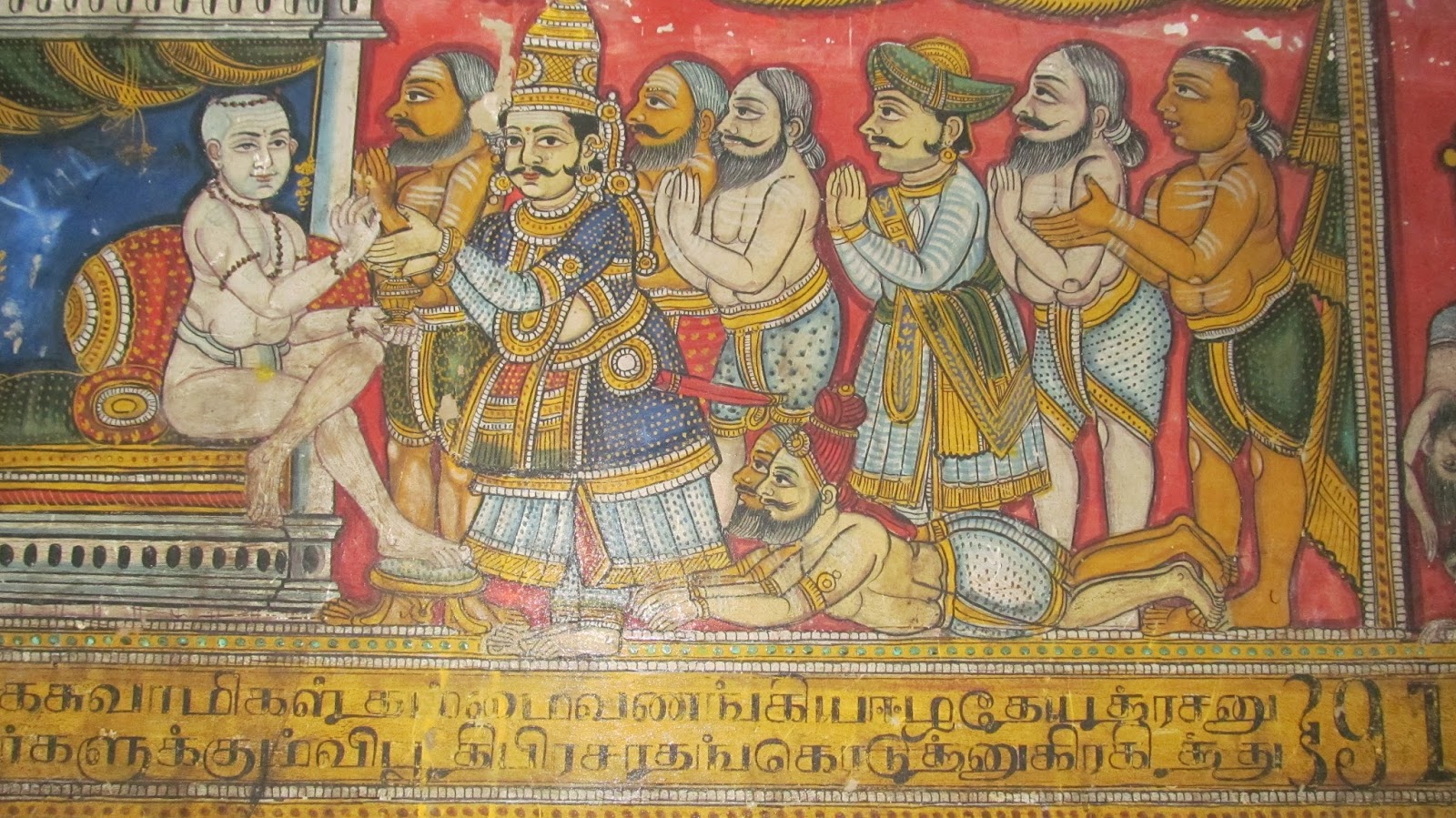
The Manivasagar sannathy in the temple is a treasure trove of ancient paintings with natural colours depicting the biography of Manbivasagar however, in the verge of extinction....  


figurative depiction of 27 constellations of stars

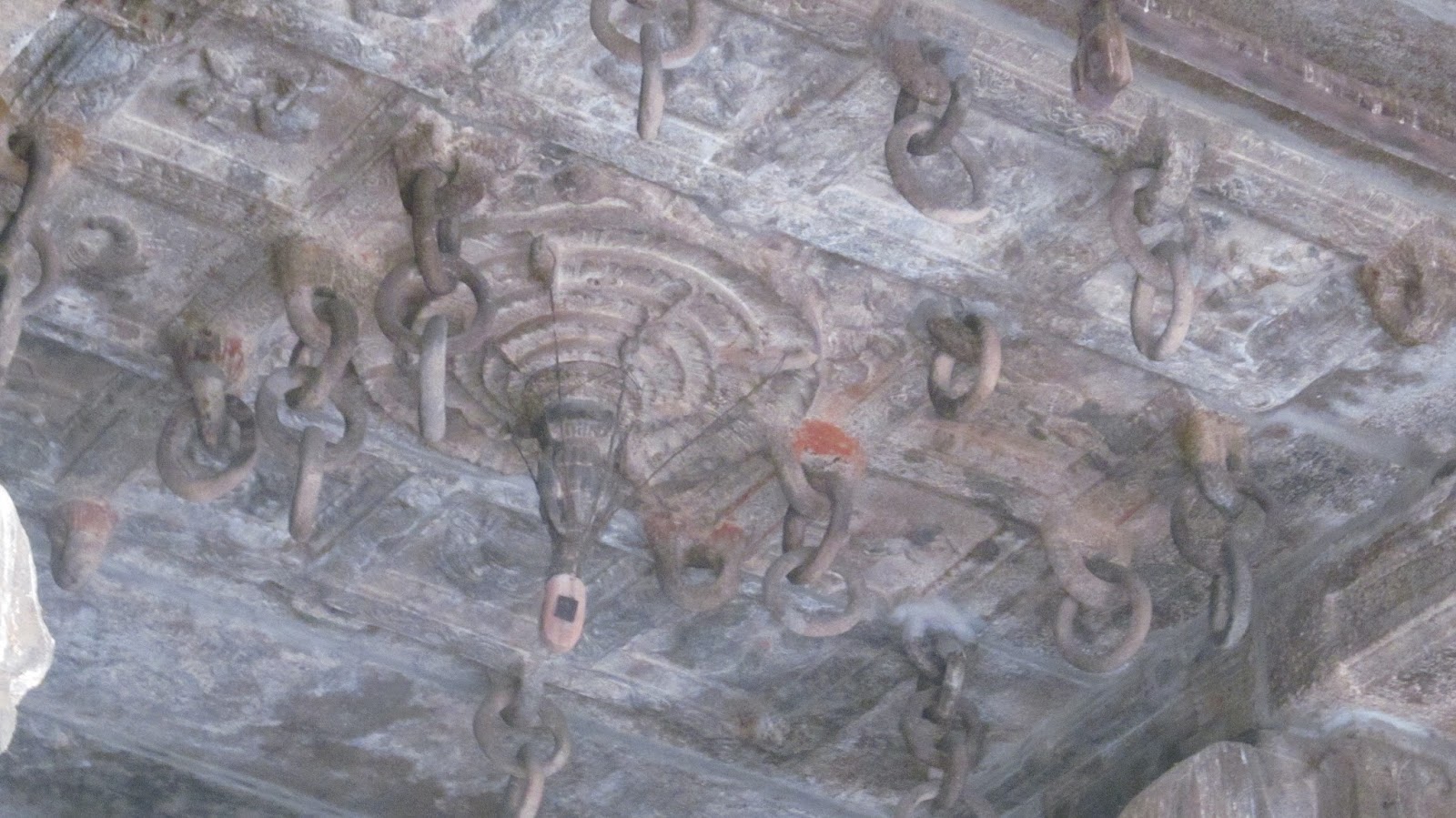
Stone chains dangling from the ceiling - the audacious expression of stone carving skills;


an ancient cavalry man with his weapons and elaborate ornaments;


The following patterns found in the huge pillars have said to have gone into textile designs;


 The temple has a number of mandaps with exquisite and intense art expressions;


Sheppard.......


Thiruvasagam Pitchiah Pillai of Tirunelveli, an authority on Thiruvasagam, explains the features of the temple;


19 March 2013

A glimpse of ‘Cheranmahadevi’ – Travelogue

 Cheranmahadevi is just in the middle of the river-stretch from Papanasam to Tirunelveli where the Tamiraparani is at her full force through the vast plains. All along the route, the river collects water from all her tributaries flowing down from the Podhigai Hills except ‘Chitraaru’ which joins the mainstream just before ‘seevalapperi’. I would like to call this river-stretch as the first phase or the Western segment of the river and the stretch from Tirunelveli upto its confluence into the Mannaar Bay may be called as the Eastern segment. Almost all the villages and towns along the course of the river are ancient human settlements. One well known example is ‘Aadhichanallur’ which is a Preserved site of the State Archeology Dept from where pre-historic artifacts are excavated.

Cheranmahadevi as the very name suggests, has Chera [Kerala] royal connection, and is a historic township on the banks of the river. Once this town should have been very close to the river banks like other nearby villages. But now the township is far away from the river course. The presence of important temples, big ghats along the river banks and ‘chekku’ - the traditional stone-wood mechanism for oil pressing said to be found amidst the river side paddy fields prove this shift of the township. The township might have transformed into fields as the fields or forest is transformed into towns. Flood might have been the primary cause as in the case of 18th Century - ‘Kaansaapuram’ – Khan Sahib Puram - on the other side of ‘Seevalapperi’ – Seevalapperi was an important junction in the ancient times –a small settlement in the name of Mohammed Yusuf Khan who once commanded British-Arcot Nawab army and led several campaigns against Pulithevar – the first native King of India who challenged the British Colonisers and succeeded in keeping them at bay for several years. Kaansaapuram was later shifted to the present ‘Burkit Managar’ named after a British Collector, Burkit – who shifted this settlement affected by the river floods.

There are several ancient temples in Cheranmahadevi [said to be about 42] denoting the cultural and economic richness of this region. This town is said to be a ‘Chaturvedi mangalam’ as per the inscriptions – i.e. a town usually established with the royal patronage - with quarters of pundits having expertise in four Vedas. One of the Nava Kailash Temples is situated at Cheranmahadevi. The popular string of Nava Kailash Temples are the nine temples placed along the banks of the river Tamiraparani from Papanasam to ‘Senthapoo mangalam’ near the confluence of the river into the Mannaar bay.  

River Tamiraparani Maa has blessed Cheranmahadevi region with her bounty and has bestowed scenic, emerald green- paddy fields up to the horizon in every direction here.


The temples are said to be with a lot of epigraphic panels – I don’t know where to get those information from. The Archeological Dept web sites reveal no such information of documentation. I approached the Tiruenlveli Archeological Dept office and learnt that the hitherto documented epigraphic details are only at Chennai Archives which are yet to be published. It is obvious that there is no exhaustive documentation and compilation of artifacts, art works and epigraphs of Tirunelveli Region.

I visited ‘Appan Kovil’ – Appan Venkatachalapathy Krishnan Temple which is right on the southern bank of the river with my colleague and friend, Hari – an admirer of art and heritage. We participated in the ‘ulavaaram’ – voluntary physical work for an hour or so with the ‘Nellai Ulavaarappani kulaam’ a team led by Sri. Muthukrishnan, an ex-air force man who is a pious, simple, and tireless organizer bent upon the mission of harnessing the youth force towards the cause of temples – he has organized thousands of ‘ulavaarams’ – voluntary efforts - in almost all the temples of Tirunelveli District and in tedious tasks of de-silting many temple-tanks.

This temple was once in sheer neglect - and I remember – was in a dilapidated condition – just in the visible distance from the road side. The tenacious efforts of this energetic ulavaaram team have paved the way for complete restoration of this temple to its present state.   

Following is the old and present state of the temple Gopuram;


The above old view has been taken from one cheranmahadevi blog. 

Below,the very same Gopuram from the inner side view at present - after renovation.


Kanadian chatram - an annadhaana chatram – choultry offering free food – which is defunct now is housed inside this temple complex.


‘Kanadian’ is the name associated with a pious, priestly youngster from the present Karnataka state who visited this region and constructed a canal – which is still referred as ‘Kanadian kaal’ -Canal, and several irrigation systems with the gifts that he received from the Chera King. This youth prayed unto Sage Agasthiya Maharishi and got his divine vision. The Sage guided him on this mission.  Several acres of agrarian lands along this canal are said to be earmarked for this choultry.

Sri. Muthukrishnan asked me to visit Sri Bakthavathsala Perumal temple just a kilometer away on the banks of the river. Baktha vathsala – a fine Sanskrit name which means one who is fond of his devotees – vaathsalya means affectionate – which implies the closeness of Vishnu Murthy to his devotees. 

This huge temple complex hidden amidst vast plantain and paddy fields - just appurtenant to a river ghat is under ASI – Archeological Survey of India - preservation.  The ASI panel informs that this temple was constructed in medieval Pandya period. ASI dates this temple to 12th Century. Few statutes of later Nayakkar royalty are also found in this temple. These royal image sculptures near the southern entrance to the second periphery are impressive and show the attire and patterns of Nayakar period. There is no more information made available by the ASI to the visitors other than this simple panel.

ASI – does’nt apply the lime – kaavi stripes – which are usually applied on the outer walls of other temples. To prevent possible acidic corrosion of lime-kaavi chemicals they are avoided – and the original stone as such is preserved by the ASI. This temple complex is a treasure trove of exquisite sculptures with minute carvings. 

We were simply taken aback by the beauty of this sculptural wonder particularly that of the kostam walls – i.e. the walls surrounding the garba-grihum - the sanctum-sanctorum. The temple is full of various patterns of lion motifs indicating Narasimha Murthy and may be also due to the royal patronage extended to this temple. The splendid architectural pattern of the inner precincts is comparable to the famed Hoysala temples. The ASI web site informs that this temple is with Chola architectural touches with inscriptions of Chola and Pandya regimes. This temple site is a centrally protected monument under the control of Archaeological Survey of India since 1921. 


Thiruvaaleeswaram temple in Ambai Taluk and two rock cut temples of 8th Century with inscriptions in Varunachimalai near Sankarankovil are the two other monuments and Kunnathur pothai – a yet un-excavated site near Tirunelveli are under central protection in Tirunelveli District.

Few views of this marvel - a ‘Kalthali’ – stone structured temple of Pandya dynasty are as below;


The main entrance to the temple in the second and third circumference walls are West-wards whereas the temple is actually East-wards.


The open corridor between the first and second periphery walls.

The high temple walls are usually made of sized stones assembled with interlocking fixtures in two rows. Inner of these two rows of stone walls are filled with binding materials such as processed lime and bricks.

Following pictures show the splendidly structured and minutely carved inner ‘kostam’ walls and circumference corridor – the inner prahaaram;


It is said the Indian art patterns symbolize ‘water’ among the elements unlike the aggressive ‘fire’ patterns of the Chinese art. Just imagine the abrupt dragon fire of the Chinese pattern which is contrary to our patterns which are usually balancing from a centre point i.e. with symmetric alignments and hence this ambiance brings in a sense of peace and tranquility to the mind of the visitor. The traditional house-‘kolams’ are also of similar in their intrinsic art pattern.


Arjunan thapas – the penance of Arjuna – as a ‘pudaippu’ sculpture i.e. embossed sculpture - on a front mandap pillar. Arjuna is seen in a perfect yogic posture with a boar in the background symbolizing the epic story of Mahabharath. Penance of Arjuna is obviously one of the popular sculptural choices of ancient sculptors - which we can spot in almost all the major temples of Tirunelveli Cheemai. However undoubtedly the master piece of this depiction is that one of the Pallava sculpture found in the Mahabalipuram rock relief. . 


A lady sculpture illustrating the ornaments, dress, hair style, makeup pattern, aesthetic sense and beauty concept of the past era


A warrior with elaborate ornaments, attire, headgear and more prominently his heavy sword - which should have been at least about 3 ½ feet in length.

Two beautiful pillars with their bases in the entrance carved as overlooking lions at the main entrance.


Views of the nearby river ghat at the Sunset;


 ~~ -  : 0 :  - ~~