Showing posts with label ukkirankottai. Show all posts

20 August 2013

A Sequel to my searches on 'Ukkirankottai’:


This is a sequel to my earlier post on ‘ Ukkirankottai' ['Ukkirankottai - towards the roots of the roots’].  

Pandya Emperor, Nedunjadayan Paranthakan [765 AD - 790 AD] – was the 7th ruler of Pandya country from the most illustrious lineage of the Early Pandyas which starts from the legendary Pandya King Kadungon who liberated the Pandya territory from the dark ages of Kalappirar – unknown – not yet identified alien rulers who subjugated and attempted to suppress the civilization of the southern Tamil Country.

Nedunjadayan was a victorious ruler. He is the only exceptional Vaishnavite ruler in the staunch Saivite Pandya dynasty.

By the way -  Sadayan, Maran, Panjavan, thennavan, valuthi and cheliyan are the popular titles assumed by the Pandya monarchs.      

There are decisive archaeological evidences in the forms of stone inscriptions and famous copper plate inscriptions such as Velvikudi plates and Sinnamanur plates apart from correlate literary evidences informing about the early Pandyas.

The archeological evidences say, that Nedunjadayan created the township, ‘ 'karavanthapuram’ at kalakkudi Nadu – i.e. the present day Ukkirankottai. He created this township purely as a garrison and placed a stationed army unit here to guard and consolidate his southern territories.

Pandya Country’s chief Minister during the reign of Nedunjadayan was ‘ Maaran Kaari’ hailed from Kalakkudi village just in the opposite bank of Ukkirankottai. Kalakkudi is a valanaadu division of Pandya country. Maaran Kaari belonged to ‘Maruthuvar’ Community – now also known as naavidhar - this community historically were traditional physicians who are now reduced to traditional barbers. Maaran Kaari of Ukkirankottai built Narasimha Perumal temple – a rock tunneled temple at Madurai – Anaimalai hill in 770 AD. After the death of Chief Minister Maaran Kaari, his younger brother, Maaran Eiyinan became the Chief Minister of Pandya Country. He completed the work of his brother at Anaimalai Narasinga Perumal temple. ‘Maaran’ was the name of their father.

Another interesting information is that another illustrious citizen hailing from Ukkirankottai, Saathan Ganapathy  [  Saathan is his father’s name – the ancient inscriptions used the present day PAN card type nomenclature system?] who also belonged to the Maruthuvar community, was the ‘Maa saamandhan’ i.e. the Commander-in-Chief of the entire Pandya Army during the reign of Emperor Nedunjadayan. From the Thirupparankundram inscriptions we come to know that this illustrious son of Tirunelveli Cheemai who commanded the army of the Pandya Country during the reign of a valorous king who had a number of victories and conquests to his credit such as victory over the Pallava army and conquest of the Kongu territory of King Adhiyamaan, also did a number of contributions to the development of Thirupparankundram temple shetram. His wife, ‘Kotri’ also said to have joined her husband’s endeavor. 


Sattan Ganapathi’s brother, Enaadhi Saathan Saathan was a Pandya army general. ‘Enaadhi’ was a title name conferred on Pandya army generals. 

I feel and believe that the above clear pieces of information as enunciated by the archaeological experts as very important and should be brought out in a big way to the present society as they reveal the fact that merit was considered over social backgrounds in the ancient Tamil country - at the least as early as in the 8th Century. It is also evident that talented people cross migrated to other professions from their traditional family trades.

Another important and parallel information from 7th  Century Tamilnadu that I would like to quote is the illustrious example of Siruthonda Nayanar – one of the adored 63 foremost saints of Tamil Saivite religious order. ‘Paranjothi’ later revered as Siruthondar in the Tamil Saivite tradition, hailed from Thiruchengaattankudi - a nondescript village in Tiruvaarur region of Kavery Delta and belonged to Maruthuvar community was the dhandanayaka or commander of Pallava Army during the conquest of Vaadhabi – the capital of Pulikesi’s Chalukkya Kingdom by Emperor Narasimha Varma Pallava. Vadhabi is the present day Badami in the Northern most border Bagalkot district of Karnataka. Sack of Vaadhabi against the formidable Pulikesi - II who had even defeated Emperor Harshavardhan is a luminous niche in the annals of Tamil history. 

Periapuranam – the 12th thirumurai – the revered book - in the order of sthothram compilation in the Saivite religion and also one of the six classical works of Tamil language with high literary value - mentions about the training Siruthondar undergone in his youth as below,
 
‘ ஆயுள் வேதக் கலையும் அலகில் வடநூல் கலையும்    
 தூய படைக்கலத் தொழிலும் துறை நிரம்பப் பயின்று…..’

Thus apart from his family profession of medicine he learnt Sanskrit literature and got trained in weaponry and warfare. By his sheer merit Siruthondar might have ascended in the ranks of Pallava army to the height of the army chief. Siruthondanallur - a village near Eral town in Tirunelveli District is named after this revered saivite saint as mentioned by the Tamil scholar, Ra. Pi. Sethupillai in his famous work,  'Tamilagam - Oorum Perum'.

Victory over Chalukyas by Pallava army is vividly narrated by Kalki in one of his three master pieces, ‘sivagamyin sabadham’.  

A full scale invasion deep into a far off hostile territory and a decisive victory over there requires a top class military organization, meticulous planning, intensive training, innovative reconnaissance techniques and enormous logistic back up. This magnificent military feat signifies the genius and immense work behind. 

There are also many Sangam age poets of higher recognition who hailed from ordinary social standings.


The 63 Nayanmars – the revered principal saints of Tamil Saivite religion, the 12 Alwars – the foremost revered saints of Tamil Vaishnavism and the enlightened spiritual leaders of Tamil Sidhar tradition hail from almost all the Tamil communities.  

The Imperial Cholas had an army regiment called ‘kaikkolar padai’. By literal meaning, the phrase ‘kaikkolar’ denotes 'men  of muscular arms' as mentioned by few historians. However this name also refers the ‘Senguthamudaliars’ – one of the Tamil weaver communities.  

Even in the modern era of well documented history, the Nerkattumcheval King Pulithevar of Nellai Cheemai enrolled Ondi Veeran Pagadai in his cavalry who was credited with several dare devil attacks on the British encampments.

Tamil Country never deprecated talents. On the contrary it recognized achievements and canonized its heroes.

It seems from the above straight evidences that people were able to cross migrate professions on their merit and choice at least to warfare. Warriors ruled the lands and commanded a position of esteemed status in the society.

A community which was in the practice of medicine would obviously formed part of the medical units of ancient Tamil armies. It is very much possible that such medical practitioners would have got into the closer rungs to the royalty and ascended in the ranks of the armies as well as. However down the time line such a social group with the sheen of power and nobility descended down to the levels of barbers during the British period.

Similarly traders exerted enormous influence on the royal clans. Agrarian communities were also at the helm of affairs in many pockets of the ancient Tamil lands. 

However Tamil social fabrics was jolted when the country’s normal life was uprooted and was in total disarray during the alien, Mogul and European invasions, subjugation and colonization. 


For just an example, the acclaimed twin Tamil novels, ‘Maanudam vellum’ and ‘Vaanam vasappadum’ based on the well-known Anandarangam Pillai’s diary portray how the social order among the Tamil communities are realigned by the colonial machinations to suit their greedy and corrupt colonial trade requirements. Our proud artisans and chivalrous warriors were reduced to mere hired classes just meant to fodder the colonial commerce in the French controlled Tamil regions. Traders, mercenaries, du-bashis [translators] and other colonial agents emerge with power and influence in the society during the French occupation of this Tamil region.  

From my understanding of what writer Jeyamohan views on castes in his blog, varnashrama system of professional classification percolated or operated from the top while the castes i.e. communities emerged from the grass roots and both collided in their courses to form a social fabric at a given point of time.

Profiling the dynamics of various social groups is a paramount requirement for formulating policies for public governance. But alas there is no serious or impartial academic efforts on these lines which has paved the way for political groups to present their distorted versions to suit their vested interests. JNU's Marxist historians pioneered colouring of discourses on Indian history after the British. 

Movements in a social order are dynamic phenomena and not at all a stagnant concept. Hence to superimpose any social distortions during tumultuous situations on the entire prior historic frame of the Tamil society is an intellectual dishonesty and just a Macaulayan inflicted preconceived notion. Instead the social transformations need objective studies.

The other important historical fact coming out from the candid archaeological evidences are that the Ukkirankottai garrison township settlement was created during the later part of the 8th century and since then this part of Nellai Cheemai is closely connected to Madurai. Development of ancient road net works necessary for troop movements may be researched in this perspective.

I also would like to compare a later garrison established by the Imperial Cholas at Thiruvaaleeswaram in Ambasamudram of Tirunelveli Cheemai. Emperor Raja Raja Chola stationed a significant unit of chola army [said to be of the size of ‘Moondru kai Mahaa Senai’ – may be an ancient Chola measure of military division]. Ambasamudram region was known as ‘Mullinaadu’ in the Pandya landscape divisions. There are several inscriptions documented from Mullinaadu region. The Cholas also stationed an army unit at Kottaru in the present day Nagercoil town. Hence the threat perception of the later Cholas was entirely different from that of the early Pandyas. The Ceylon country was not in the count at the time of later Cholas who had subjugated that country decisively. Hence the placement of imperial Chola troops near the borders of Chera Country is noteworthy.  

The Tamil military system of stationing sufficiently strong troops well within the native country but at vantage locations in proximity from the border ranges with sufficient hinterland road network and logistic support possibilities may be analyzed vis-à-vis the modern contexts such as the so called ‘cold start’ military doctrine of the Indian Army or the Chinese threat matrix that we face now.  


24 April 2013


UKKIRANKOTTAI - In search of the roots of the roots:

For a long time I am enchanted with the pieces of historic information about King Ukkira Pandya who built the Sankaranainar Temple at Sankarankoil of Tirunelveli District.

It was a ‘karna paramparai’ information [word of mouth passed over to generations – may I call it the ‘folk history’ of the locality?] that the devoted king, who still stands as a life size statute in the inner precincts of Sankarankoil temple in a worshipping form, before our lord Sankara Nainaar, that he arranged the bricks required for the temple construction brought from his township Ukkirankottai, by passing through a human chain of his men covering a distance of about 33 kms.

King Ukkira pandya who probably ruled the North Western part of Nellai Cheemai, in the 11th Century from Ukkirankottai used to visit Madurai frequently through the present Sankarankoil tract which was once a forest of auspicious ‘punnai’ trees as per the ‘sthala puranam’ i.e. the temple township history. During one such journey, through the above forest, the royal elephant suddenly became unruly and eventually tumbled into a pit.  At that time the king was informed by a forest watch man, that he had just found an unusually strong and radiant cobra in an anthill that he removed inside the forest. Perturbed by the combination of the above events, the King visited the spot accompanied by the watch man and saw a shiva lingam in the anthill. On the oracle that he received at that moment, the king embarked on the mission of constructing a grand temple for lord Shiva there.


SANKARA NAINAAR TEMPLE

The temple history says that King Ukkirapandiya completed the core of the temple and one of his late successors, King Veeraseevala mara Pandya further developed the temple precincts and accomplished the construction of outer walls and the magnificent Raja Gopuram which is one of the few majestic Raja Gopurams towering into the skies of Nellai cheemai. Other magnificent Rajagopurams studding our land are at Tirunelveli, Tenkasi, Tiruchendur, Tirupudaimarudhur, Brahmmadesam and Papanasam. King Veeraseevala mara pandya was said to be guided by the then pontiff of Thiruvavaduthurai Mutt. 

Sankarankoil temple is a ‘Prithvi sthalam’ i.e. representing the Earth among the ‘pancha bootha shetrams’ – five shetrams representing the elements – the remaining temples are at Dhaarugapuram, Dhevathaanam, Thenmalai and Karivalamvanthanallur in the nearby localities.

Punnai, a Southern peninsular tree is the ‘sthala vrisham’ i.e. the revered and auspicious tree of the temple and the locality. The earth ceremoniously brought to the temple from the ancient Punnai forestry which was in the South Western part of the present town is considered as an auspicious ‘prasaad’ having curative properties by the devotees. Punnai tree has surprisingly similar rhyming names in other languages also – ‘punnang’ in Bengali   and ‘bunga’ in Malay. In Sanskrit it is ‘punnaga’ or ‘nagachampa’.

11th Century - the time of Ukkirapandya - is the period when the Pandya Army was completely subjugated by the emerging Chola military might, heralding the meteoric rise of the Later Chola Dynasty with the spade work laid by Emperor Paraanthaga Chola. From the position of King Ukkirapandya it can be surmised that even at the time of fallen glory, the Pandya hinterlands were never conquered by the Cholas. Hence the Cholas could not cast their sway beyond Madurai at that time. It can be assumed that the King Ukkirapandya should be a vassal of the Pandya ruling dynasty of Madurai.

Website of ASI-Archeological survey of India informs that they conducted excavations in Ukkirankottai, way back in 1970-71. But I don’t know how to access the documentation of the resultant findings arrived. I had a long time curiosity to visit Ukkirannkottai, named after this competent King Ukkira Pandya.

Ukkirankottai by its very name suggests a walled area in the name of the King Ukkira Pandya. The Sanskrit meaning of the term ‘ugra’ is ‘fierce’. Ukkirankottai is now just a small township, 36 kms away from Tirunelveli, on the Northern banks of ‘Chitraru’, one of the two major tributaries of river Tamiraparani. I noticed a clearly discernible circular feature in the wikimapia satellite image of Ukkirankottai which kindled my interest further. One of my friends, Kannan, a welder and steel furniture maker by profession enthusiastically volunteered to accompany me.

We first visited the Shiva temple at Ukkirankottai. Curiously this temple priest is a vaishnavite. The resourceful priest confirmed the karna-parampara information about the bricks passed by way of a human chain upto Sankarankoil by king Ukkirapandya.

Other related information that are still in the realm of folk lore memory, we came to know are that Kalakkudi, a fertile village on the southern banks of Chitraru just opposite to Ukkirankottai was only the ‘naadu’ or regional centre, though the political seat of power was at Ukkirankottai; that Ukkirankottai was originally known as ‘Karavantha puram’ before it was named after the King Ukkira Pandya. The 12th check dam across the Chitraaru River is colloquially referred as ‘kadappurathu anai’. 'Kadappuram' is a broken word from 'Karavanthapuram'. The king had two wise councilors, Saathan Ganapathy and Maran Ganapathy hailing from Kalakkudi; that they were brothers and from ‘maruthuvar’ community.  They were said to be closely associated with Anaimalai locality in Madurai. It is evident that in the ancient Tamil country merit was considered over the background of a person. 

In the outskirts of the town, to our surprise and chill we found a circularly formed ancient ‘agali’ structure ['moats' i.e. defensive  channel running around a fortification] still noticeably intact. We were actually thrilled to see the enormous breadth and depth of this nearly 900 years old ‘agali’! However there was no trace of the ancient walls for locating which elaborate excavations may be required. Though the ‘agali’ structure is still discernible it is almost in the course of its fast disappearance.

The agali is somewhat perfectly circular in shape running around Ukkirankottai Township. However to my disappointment, diameter of the circular area formed by the agali spans approximately to one km only, suggesting only a smaller fortification than what I expected. About two thirds of the Eastern parts of the encircled area is now of paddy fields. The residential quarters are at the southern most corner portion of this encircled area of the present township. Considering the topography of the Western parts of the encircled area with mounds and the two thirds part of the encircled area in the East under agro cultivation, there is a fair possibility of finding ancient structures if selective excavations are carried out in these locations. The bulk of the present township being outside this agali structure also strengthens this observation.

Almost at the centre of this circular formation there exists a mound with scattered ruins of an ancient temple. Amidst the ruins, few shattered brick work structures alone are found. There are no stone structures left out. Local people told us that was the place where the Shiva temple originally existed. During the British period the British rulers said to have taken away the stone structures of the temple and used them to strengthen the two ancient diversion barrages existed across the River Chitraaru.

One such barrage structure is across Ukkirankottai - Kalakkudi which is the 13th barrage across river Chitraru under the maintenance of the State PWD and the other one is at Western ‘Vaal Veechu Rastha’ [ this is 12th barrage across the river from its origin point]. These barrages are part of the ancient irrigation systems helping to divert the seasonal flood waters from the river to irrigation tanks of the region. However the agali is said to be watered in olden days by two other nearby tanks in the West which we have not visited.

The present shiva temple located at the Southern part of the circular agali feature was said to be a vaishnavite shrine later changed into a saivite temple after the dilapidation of the original temple. The Vaisnavite shrine ‘vigrahas’ [idols] were said to be trans-located to another vaishnavite shrine at nearby Rediyarpatti village. One could see numerous ruined temple idols in this temple. We were able to spot several damaged idols / sculptures scattered in the surrounding paddy fields also.

The ‘vadakku vassal’ [literally meaning Northern gate] selvi amman temple has a beautifully carved out old Nandhi statue [Shiva’s bull]. Nandhi vigraha is found only in a Shivite temple. It is very clear that this nandhi statue has been relocated from the dilapidated shrine of Shiva. Vadakku vassal selvi amman temple as the very name suggests which marks the northern boundary of the fortification is located at the Northern bank of the present agali – which should have been near the Northern pass to the earlier fortification. Local people informed us about the excavations carried out by Archeologists in this place some decades back [probably by the ASI].

Northern and Southern portions of the agali are clearly discernible. Whereas the Eastern and the Western parts of the agali is gradually in the withering course as they are slowly converted in to agricultural fields.

A vast irrigation tank called, ‘padalayar kulam’ is situated along the southern side of Ukkirankottai.  Famed magnificent irrigation sources of the region, ‘Veeranam tank’, ‘Ettaankulam’ and the ‘Manur tank’ are other irrigation systems of this region. The entire territory along the course of the river from Courtaalam to Seevalaperi where the Chitraaru River merges with Tamiraparani is studded with ancient localities with fertile and scenic paddy fields. Veeranam and Veerakeralampudur are the nearby places on the banks of the river in the western side of Ukkirankottai. Veeralakeralam pudur was the Hqrs of adjoining Uthumalai Zamin region bordering Ukkirankottai. Ukkirankottai was an ‘ayan village’ i.e. area under the British rule while the nearby Uthumalai Zamin was ruled by an independent ruler like the independent principalities of Ettayapuram, Tanjore and Pudukkottai during the British Raj.

Dr. U.Ve.Sa., in his auto biography says that he stayed at Veerakeralampudur as a guest of the Zamindaar during his famed journeys in search of original palm leaf records of ancient Tamil literature during the early part of the previous century. He mentions that during his stay at Veerakeralampudur he enjoyed refreshing baths at the Chitraaru River - something which is unthinkable now as the river has pathetically reduced to mere scattered and stagnated puddles. How could we trace the reasons for such a declining flow? Perhaps the reason is the rains! I remember to have heard my maternal grandma – my grandpa being a migrant from ‘Ayirapperi village’ close to the Courtalam hills – the catchment area of Chitraru River - telling me that there would be copious rains extending even beyond the rainy season almost to the extent of nine months of the year. The enormous irrigation systems and sufficient rain falls in the past era might have supported the ancient settlements such as paavoor, Manur and Ukkirankottai in this river region – which has been now reduced to somewhat dry and barren within two generations.   

Ukkirankottai is located on the ancient route towards Tenkasi. This route possibly might have touched Seevalaperi the ancient junction point, [probably Sree vallapa Peri – probably named after a Pandya King, as ‘Sree vallaba’ is one of the popular names in the Pandya lineage]. Even the later Rani Mangamma trunk road from Madurai might have passed through this junction point to reach Kanyakumari. There were similar trunk roads from Madurai to Tiruchi, and Rameshwaram with chatrams [choultries] for the travelers at least at every walking distance of a day.

VM Chatram [ Veera Raghava Mudaliar Chatram ] is one such chatram situated on the Rani Mangammal Salai. The main road of KTC Nagar in Tirunelveli is still called Rani Mangammal Saalai which ends at VM Chatram.

Pavoor chatram and panavadali chatram are two examples of ancient choultry points meant for travelers - later developed into townships in Tirunelveli district. One of my colleagues from ‘Moovirunthaali’ – an ancient village near Ukkirankottai informed me of the presence of a stretch still referred as Rani Mangammal saalai in his locality by the elders of his village. Sketching of the ancient trunk roads itself would be a great deal of research calling for efforts and tenacity.

Thus Ukkirankottai appears to be on a strategic location for a stationed Pandya reserve army which could be swiftly moved to the ‘Aryan-kaavu’ pass in the Western borders or to the South Eastern Korkai port or even to the capital, Madurai in times of need to assist the main body of the Pandya Army. Manarpadaiveedu near Seevalapperi is another ancient 'padaiveedu' or army barracks of this region. There might be a network of stationed army barracks converted into settled reserve pools of soldiery in the Pandya country. Mobilization of the entire state army at the time of call might be organised from such strategic locations. 

‘Vaal veechu Rastha’ is the adjoining village to Ukkirankottai mainly inhabited by ‘Maravar’ community - one of the ancient warrior communities of the region - the name indicates an area for sword practice. Another nearby village is called Rasthaa which simply means a trunk road.

We decided to visit the two barrages and check for the temple stones said to have been used in strengthening these structures by the British.  

In the northern part of the 13th barrage across river Chitraaru at Ukkirankottai-Kalakkudi banks a Saastha temple is located. This temple is called ‘anai thalai’ [meaning at the head of the dam] Saastha temple. Subsequently we visited the 4.40 kms long Vaal veechu Rastha barrage in the West [which is the 12th barrage across Chitraaru which is known as Ukkirankottai dam] through Kalakkudi - a fertile agrarian village and Seethaikurichi – which is one of the Ramayana related localities along the Chitraaru river course –

         other such sites being, the Ramar temple atop a hillock in          the  Western part of Paavoor chatram, Seethakarpanallur,  Maayamaankurichi and Maanur.  Kaattu Ramar koil, Jadaayu theertham, and Ramanaatha swamy temple all at Arugankulam village at the Northern bank of Tamiraparani and the Kurangani amman temple at the Tamiraparani river, leading towards Vaalinokkam and Sethukkarai in the Eastern shore are other Ramayana related locations thus stretching towards Rameshwaram island. 

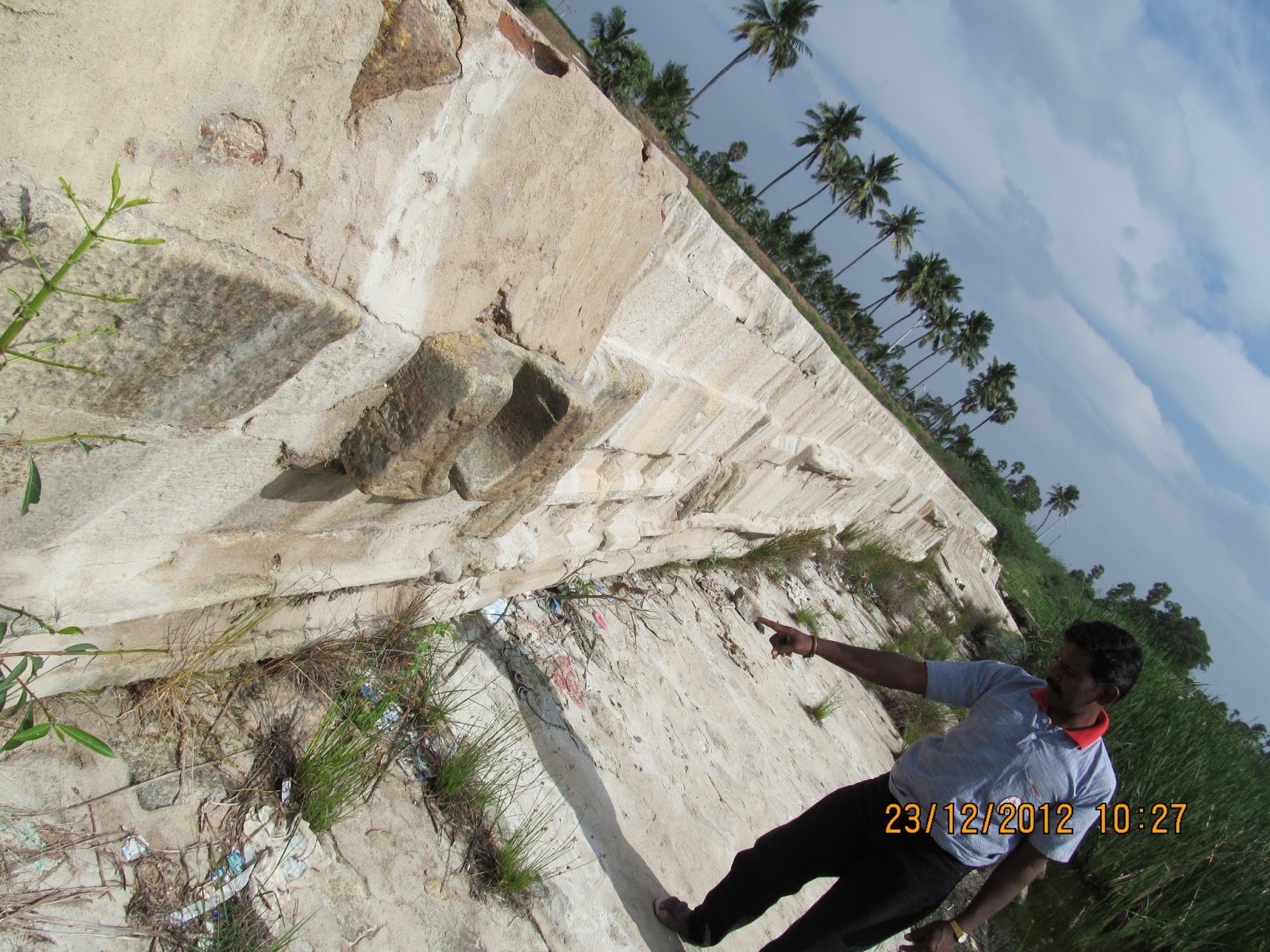
Both the barrages to our surprise contained many temple artifacts, temple stone structures, carved beams and even one epigraphic panel in Ukkirankottai-kalakkudi barrage wall and we found a panel of Vinayagar idol in Western Vaalveechu rastha barrage. We could’nt go near the epigraphic panel due to its precarious positioning on the steep barrage wall. These 12th and 13th barrages are of three tiers - the base being made of ancient brick works and a secondary stone structure – probably the one made by the British on it and with latest cement masonry topping on it. Ancient bricks are identifiable and different from the present chamber bricks as they are patterned in lean and broader size and baked of finely ground sand. Hence the diversion barrages across Chitraaru are part of the ancient irrigation systems similar to the ones on River Tamiraparani.

The present Shiva temple at Ukkirankottai township contains many epigraphic panels which we could’nt decipher. We came to know that the former District Archeology Officer, Dr. Senthil Selvakumaran of Tirunelveli surveyed these sites, and documented the epigraphic information. He is retired now. I visited him recently. In spite of his infirmity and poor health enthusiasm sparkled in his eyes when he enquired about the agali structure and the Vadakku vassal Selvi amman temple. He also recollected that the epigraphic letters documented were of ‘vatteluthu’ pattern. He is too weak due to his sickness and couldn’t recall the content information. He said the documents are with the state archeology dept. He also advised me to refer volumes 13 and 23 of South Indian Inscriptions compiled by the ASI which I am unable to source.

The padayarkulam tank in the southern outskirts of Ukkirankottai is watered by Ukkirankottai kaal i.e. Ukkirankottai Channel from the Vaalveechu rastha barrage.

We could spot few households of potter community – who might also be the traditional brick makers of ancient days in Ukkirankottai.  Alagiya pandyapuram is the nearby junction in the Tirunelveli – Sankarankoil state highways.

The nearby Reddiyarpatti village having a recent name of Vijayanagar period is known for its weekly cattle santhai – i.e. traditional periodical cattle market. The soil pattern around Ukkirankottai appears to be with rich lime stone content though the lime stone quarries are located some 20 kms away from this locality.  

Even today during excavations for new constructions, many ancient artifacts are said to be found in this village. State Archeology department has said to be recovered few of them and placed at Palayamkottai museum.

The legendary King Pulithevar of Nerkattumcheval hailing from the Western parts of Tirunelveli Cheemai was the first native king of the Tamil country and perhaps of the Indian subcontinent to give a formidable military resistance to the British colonizers. He may be considered to be from the lineage of King Ukkirapandya. Pulithevar is also an ardent devotee of Lord Sankaranainaar. An ornately carved wooden memorial structure is dedicated to this popular and pious king in the Sankarankoil temple.

May the grass roots history of our Tirunelveli Cheemai showing simple living of our ancestors with pristine and lofty ideals be brought out and preserved for the posterity. I pray unto the devoted and able King Ukkira Pandya to bless this land to bestow heroic sons in the service of mother India and thereby sustain the glory of our Tirunelveli Zilla.

The present Shiva temple of Ukkirankottai housing Sri Meenakshi Sundareswara swamy:


The fish insignia – i.e. the Pandya State emblem found on the roof of the shiva temple:


This beautiful nandi statue should have been brought from the ruined ancient shiva temple to his present location at Selvi Amman Temple:


Northern course of the 900 years old agali:


Western parts of the Agali – with some 15 feet depth:


The broad structure of the agali with its banks here in the West is clearly visible:


The agali becoming part of the populated township in the South where it is shrunk with new banks:


Encroached by bush thickets in the South East:


The mound and scattered ruins of the ancient Shiva temple:


The view of the sprawling Padalayar tank at the southern outskirts of Ukkirankottai which is watered by the 12th barrage channel:


13th barrage across river Chitraaru linking Ukkirankottai and kalakkudi with temple stone structures:


The epigraphic panel of the ruined temple found at the 13th barrage:


The old brick work structure is beneath the stone structure:


The stagnated pool of water at the 13th barrage:


Ukkirankottai temple parts found in the 12th river barrage-
at Western Vaalveechu rastha :


The scenic surroundings of the 12th barrage:


~ ~ : 0 : ~ ~